Skip to content

Home World Time Zones

--:--:--UTC
Time · updated October 2026

Every time zone on Earth, right now

The planet runs on 38 different local times, from UTC−12 to UTC+14. Eleven of them aren’t even whole hours. The real borders between them follow countries and politics, not the sun. Drag the ribbon above to travel through the day and watch the map, the clocks and the meeting planner move with you.

38UTC offsets
in use today
one colour per offset, west to east night, for the time on the ribbon offsets that aren’t whole hours Tap or hover a zone for its local time.
Two dates at once

Right now the world is living on two dates

The wall of clocks

One clock for each of the 38 offsets

Standard time for every offset, west to east, with the people who live by it and the countries that use it. A white outline marks the half-hour and 45-minute offsets. Gold marks the zone where the newest day has just begun. Countries that use daylight saving move one hour forward in their summer.

Why the lines bend

Nine stories behind the map

Time zones began with railways in the 1880s as neat 15° slices of the globe. Then governments drew their own lines.

UTC+8

China: one clock for 5,000 km

China has kept Beijing time across the whole country since 1949. In far-western Kashgar, the winter sun doesn’t rise until after 9:30 in the morning. Many people in Xinjiang informally keep a local time two hours behind.

UTC+5:45

Nepal: fifteen minutes apart

Nepal set its clocks to the meridian of Mount Gauri Shankar in 1986, which put it 15 minutes ahead of India. Only Nepal, New Zealand’s Chatham Islands (+12:45) and Eucla in Western Australia (+8:45, unofficially) use 45-minute offsets.

UTC+14

Kiribati: first into each new day

Until 1995 the date line split Kiribati, so its islands were a day apart. Kiribati then moved its eastern Line Islands to UTC+14, bending the date line far to the east. Kiritimati is now the first inhabited place to see each new day.

UTC+13

Samoa: the Friday that never was

To keep the same working days as Australia and New Zealand, Samoa jumped across the date line at the end of 2011. Thursday 29 December was followed by Saturday 31 December. American Samoa, 100 km away, stayed behind: the two are now a full day apart.

UTC−7 · −6 · −5

Canada, 2026: no more clock changes

British Columbia, Alberta, the Northwest Territories and Manitoba have chosen to keep summer time all year, from November 2026. Clocks in western Canada will no longer “fall back” in autumn. The map, built from the time zone database, already shows their new offsets.

UTC+0

Morocco, 2026: back on GMT

Morocco moved to UTC+1 in 2018 and switched back an hour every Ramadan. On 20 September 2026 it returned to UTC+0 for good, its natural time, the same as the United Kingdom in winter.

UTC+1

Spain: on Berlin time

Geographically Spain belongs to the same zone as London and Lisbon. In 1940 it moved its clocks to Central European Time and never moved back. That is one reason Spaniards eat lunch at two and dinner at nine.

12 zones

France: the most time zones

Counting its territories from French Polynesia (UTC−10) to Wallis and Futuna (UTC+12), France spans 12 time zones, more than any other country. The United States and Russia have 11 each.

UTC+2 … +12

Russia: eleven zones, one country

When it is 8 a.m. in Kaliningrad, it is 6 p.m. in Kamchatka. Russia cut its zones to nine in 2010, then restored them to eleven in 2014 after complaints about dark mornings.

Meeting planner

When can four cities talk?

Pick up to four cities. The grid shows the date on the ribbon, hour by hour in the first city’s time, with daylight saving applied where it’s in force on that date. Green means 9 a.m.–5 p.m., amber is early or late, purple is the middle of the night. White outlines mark hours that work for everyone.

Population

Where 8.1 billion people tell the time

People living under each standard offset, estimated by splitting every country’s 2024 population between its zones by where its cities are. Two clocks dominate: UTC+8 (China, the Philippines, Malaysia, Singapore, Western Australia) and UTC+5:30 (India and Sri Lanka) together cover almost two in five people on Earth.

Departures board

All 38 UTC offsets, with their countries

Standard (winter) offsets for 2026/27 from the IANA time zone database, including the Canadian and Moroccan changes. Territories are listed under their own names. “Summer +1h” lists the places that add an hour for daylight saving.

Every standard UTC offset in use, people living under it (approximate) and the countries and territories that use it.
OffsetPeopleCountries and territoriesSummer +1h
UTC−12—Baker Island and Howland Island (uninhabited, US)—
UTC−11—Niue, Samoa (American), US minor outlying islands—
UTC−102 mCook Islands, French Polynesia, United StatesUnited States
UTC−9:30—French Polynesia—
UTC−9< 1 mFrench Polynesia, United StatesUnited States
UTC−875 mMexico, Pitcairn, United StatesMexico, United States
UTC−741 mCanada, Mexico, United StatesCanada, Mexico, United States
UTC−6256 mBelize, Canada, Chile, Costa Rica, Ecuador, El Salvador, Guatemala, Honduras, Mexico, Nicaragua, United StatesCanada, Chile, Mexico, United States
UTC−5321 mBahamas, Brazil, Canada, Cayman Islands, Colombia, Cuba, Ecuador, Haiti, Jamaica, Mexico, Panama, Peru, Turks & Caicos Is, United StatesBahamas, Canada, Cuba, Haiti, Turks & Caicos Is, United States
UTC−493 mAnguilla, Antigua & Barbuda, Aruba, Barbados, Bermuda, Bolivia, Brazil, Canada, Caribbean NL, Chile, Curaçao, Dominica, Dominican Republic, Greenland, Grenada, Guadeloupe, Guyana, Martinique, Montserrat, Puerto Rico, St Barthelemy, St Kitts & Nevis, St Lucia, St Maarten (Dutch), St Martin (French), St Vincent, Trinidad & Tobago, Venezuela, Virgin Islands (UK), Virgin Islands (US)Bermuda, Canada, Chile, Greenland
UTC−3:30< 1 mCanadaCanada
UTC−3257 mArgentina, Brazil, Chile, Falkland Islands, French Guiana, Paraguay, St Pierre & Miquelon, Suriname, UruguaySt Pierre & Miquelon
UTC−2< 1 mBrazil, Greenland, South Georgia & the South Sandwich IslandsGreenland
UTC−1< 1 mCape Verde, PortugalPortugal
UTC+0306 mBritain (UK), Burkina Faso, Côte d’Ivoire, Faroe Islands, Gambia, Ghana, Greenland, Guernsey, Guinea, Guinea-Bissau, Iceland, Ireland, Isle of Man, Jersey, Liberia, Mali, Mauritania, Morocco, Portugal, Sao Tome & Principe, Senegal, Sierra Leone, Spain, St Helena, Togo, Western SaharaBritain (UK), Faroe Islands, Guernsey, Ireland, Isle of Man, Jersey, Portugal, Spain
UTC+1908 mAlbania, Algeria, Andorra, Angola, Austria, Belgium, Benin, Bosnia & Herzegovina, Cameroon, Central African Rep., Chad, Congo (Dem. Rep.), Congo (Rep.), Croatia, Czech Republic, Denmark, Equatorial Guinea, France, Gabon, Germany, Gibraltar, Hungary, Italy, Liechtenstein, Luxembourg, Malta, Monaco, Montenegro, Netherlands, Niger, Nigeria, North Macedonia, Norway, Poland, San Marino, Serbia, Slovakia, Slovenia, Spain, Svalbard & Jan Mayen, Sweden, Switzerland, Tunisia, Vatican CityAlbania, Andorra, Austria, Belgium, Bosnia & Herzegovina, Croatia, Czech Republic, Denmark, France, Germany, Gibraltar, Hungary, Italy, Liechtenstein, Luxembourg, Malta, Monaco, Montenegro, Netherlands, North Macedonia, Norway, Poland, San Marino, Serbia, Slovakia, Slovenia, Spain, Svalbard & Jan Mayen, Sweden, Switzerland, Vatican City
UTC+2543 mBotswana, Bulgaria, Burundi, Congo (Dem. Rep.), Cyprus, Egypt, Estonia, Eswatini (Swaziland), Finland, Greece, Israel, Latvia, Lebanon, Lesotho, Libya, Lithuania, Malawi, Moldova, Mozambique, Namibia, Palestine, Romania, Russia, Rwanda, South Africa, South Sudan, Sudan, Ukraine, Zambia, Zimbabwe, Åland IslandsBulgaria, Cyprus, Egypt, Estonia, Finland, Greece, Israel, Latvia, Lebanon, Lithuania, Moldova, Palestine, Romania, Ukraine, Åland Islands
UTC+3709 mBahrain, Belarus, Comoros, Djibouti, Eritrea, Ethiopia, Iraq, Jordan, Kenya, Kuwait, Madagascar, Mayotte, Qatar, Russia, Saudi Arabia, Somalia, Syria, Tanzania, Turkey, Uganda, Ukraine, Yemen—
UTC+3:3092 mIran—
UTC+446 mArmenia, Azerbaijan, Georgia, Mauritius, Oman, Russia, Réunion, Seychelles, United Arab Emirates—
UTC+4:3043 mAfghanistan—
UTC+5349 mFrench S. Terr., Kazakhstan, Maldives, Pakistan, Russia, Tajikistan, Turkmenistan, Uzbekistan—
UTC+5:301.47 bnIndia, Sri Lanka—
UTC+5:4530 mNepal—
UTC+6184 mBangladesh, Bhutan, British Indian Ocean Territory, Kyrgyzstan, Russia—
UTC+6:3054 mCocos (Keeling) Islands, Myanmar (Burma)—
UTC+7442 mCambodia, Christmas Island, Indonesia, Laos, Mongolia, Russia, Thailand, Vietnam—
UTC+81.65 bnAustralia, Brunei, China, Hong Kong, Indonesia, Macau, Malaysia, Mongolia, Philippines, Russia, Singapore, Taiwan—
UTC+8:45—Australia—
UTC+9213 mEast Timor, Indonesia, Japan, Korea (North), Korea (South), Palau, Russia—
UTC+9:302 mAustraliaAustralia
UTC+1037 mAustralia, Guam, Micronesia, Northern Mariana Islands, Papua New Guinea, RussiaAustralia
UTC+10:30—AustraliaAustralia
UTC+113 mMicronesia, New Caledonia, Norfolk Island, Papua New Guinea, Russia, Solomon Islands, VanuatuNorfolk Island
UTC+127 mFiji, Kiribati, Marshall Islands, Nauru, New Zealand, Russia, Tuvalu, US minor outlying islands, Wallis & FutunaNew Zealand
UTC+12:45—New ZealandNew Zealand
UTC+13< 1 mKiribati, Samoa (western), Tokelau, Tonga—
UTC+14—Kiribati—
Questions

Time zones, answered

How many time zones are there in the world?

38 different UTC offsets are in use today, from UTC−12 (only the uninhabited Baker and Howland islands) to UTC+14 (Kiribati’s Line Islands). 27 of them are whole hours. The others are 30 or 45 minutes off: Iran, Afghanistan, India, Nepal, Myanmar, Newfoundland, central Australia, the Marquesas and the Chatham Islands. The time zone database itself lists more than 400 named zones, because places with the same clock today often had different histories.

Which country has the most time zones?

France, with 12 time zones when its overseas territories are counted. The United States and Russia follow with 11 each. Russia has the most on one continuous stretch of land, from Kaliningrad (UTC+2) to Kamchatka (UTC+12).

Why does China have only one time zone?

Since 1949 the whole of China has officially used Beijing time (UTC+8), although the country is about 5,000 km wide and spans five geographic zones. In the far west the sun rises and sets very late by the clock, and many people in Xinjiang informally use a local time two hours behind.

Where does each new day begin?

Kiritimati (Christmas Island) in Kiribati, on UTC+14, is the first inhabited place to reach midnight. The last are American Samoa and Niue on UTC−11, 25 hours later. For a couple of hours every day, three different dates are in use on Earth at once.

What is the International Date Line?

It is the line, roughly along the 180° meridian, where the calendar date changes: crossing it westward adds a day. It zigzags around island nations so each one keeps a single date. The largest bend, made by Kiribati in 1995, pushes it about 2,500 km to the east.

Which places stopped changing their clocks in 2026?

British Columbia, Alberta, the Northwest Territories and Manitoba in Canada stay on summer time all year from November 2026. Morocco left UTC+1 for UTC+0 permanently on 20 September 2026. Earlier, Mexico (2022), Iran (2022), Jordan and Syria (2022) and Paraguay (2024) also ended their clock changes.

How many countries still use daylight saving time?

About 53 of the 193 UN member states still move their clocks in summer, sometimes in only part of the country. Most are in Europe and North America, plus Chile, south-eastern Australia, New Zealand, Egypt, Israel, Lebanon, Cuba and Haiti. Most of Africa and Asia never changes the clocks.

What is the difference between UTC and GMT?

GMT is the old astronomical time at the Greenwich meridian in London. UTC, Coordinated Universal Time, is kept by atomic clocks and is the standard behind every offset on this page. For everyday purposes they show the same time, but UTC is the scientific reference.

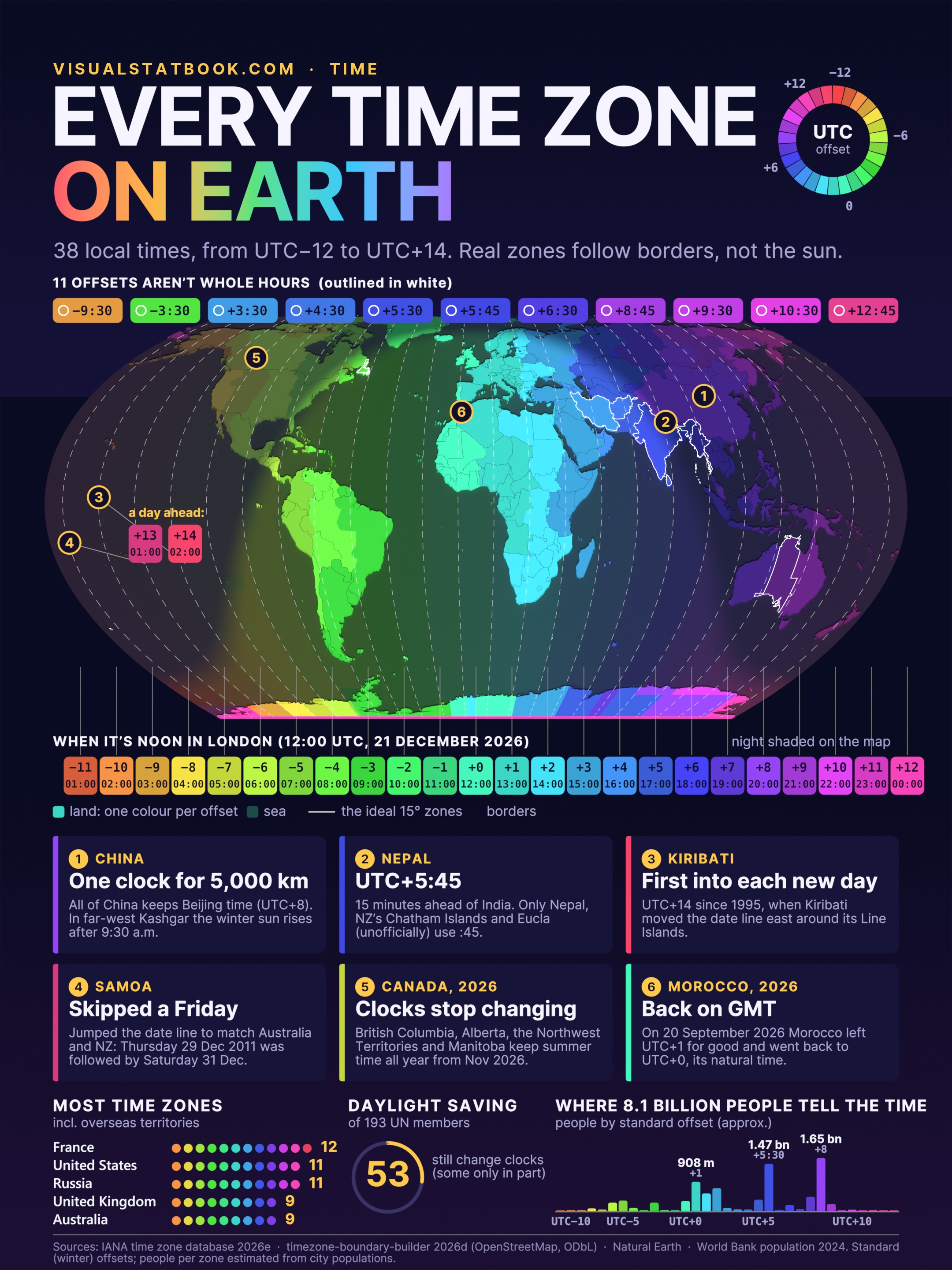
Poster: Every Time Zone on Earth. A 3D world map coloured by UTC offset with the night side shaded for 12:00 UTC on 21 December 2026, a strip of local times when it is noon in London, six stories (China, Nepal, Kiribati, Samoa, Canada 2026, Morocco 2026), the countries with the most time zones, daylight saving use and population by offset.
Every Time Zone on Earth · poster, 2160 × 2880
The poster

Every time zone on Earth, on one sheet

The same data as a print: a 3D world map with every offset raised in its own colour, the night side for 12:00 UTC on the December solstice, and the local time in every zone at that moment.

  • 38 offsets, with the 11 that aren’t whole hours outlined
  • The ideal 15° zones dashed over the real ones
  • Six stories, the countries with the most zones, daylight saving and population

Sources. IANA time zone database 2026d/2026e. Zone boundaries: timezone-boundary-builder 2026d (built from OpenStreetMap, ODbL). Land and borders: Natural Earth. Population: World Bank 2024, split between zones using Natural Earth populated places (an approximation). Local times on this page come from your browser’s own time zone data.