


Interactive 3D
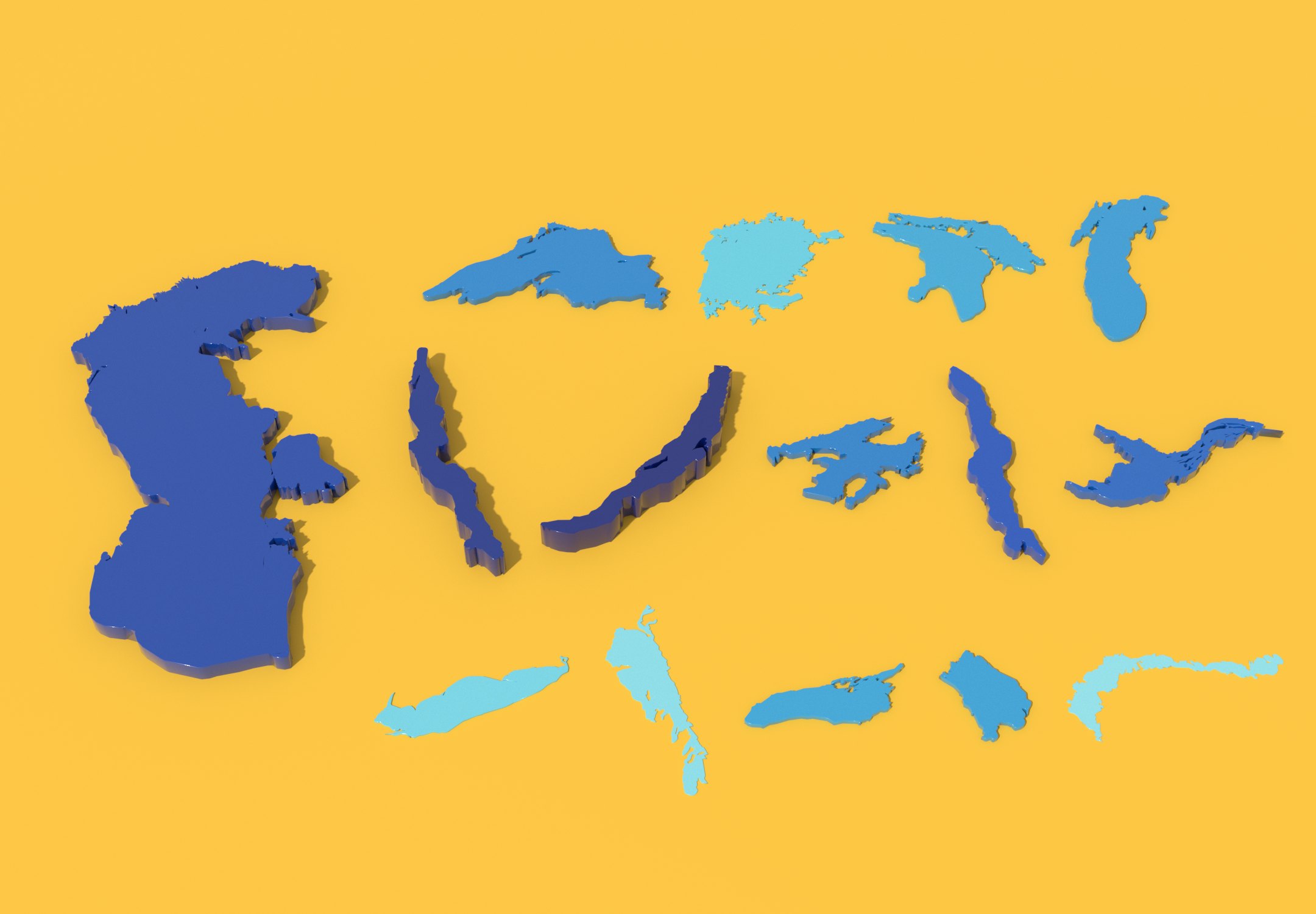
All 30 lakes in 3D
Every lake’s true outline at one scale, raised by its maximum depth. Drag to orbit, switch the layout, and tap a lake for its numbers.
The 3D view needs WebGL, which this browser has turned off. The comparison and charts below show the same lakes.
Real relief
Every lake, modelled from real relief
Each block is cut from satellite elevation and imagery around one lake: its true outline, the real hills and plains around it and, where surveys reach it, the lake floor. Tap a block to pick that lake in the 3D view.
Where ETOPO 2022 maps the lake floor (Caspian Sea, Superior, Huron, Michigan, Baikal, Erie and Ontario), darker water means deeper water; for the other 23 lakes only the surface is shown. Heights are exaggerated as marked on each card, and scale bars give east–west distance at the lake’s centre.
Same scale
Compare two lakes at the same scale
Both true outlines are laid centre on centre at the same pixels per kilometre.
Water volume
How much water each lake holds
Each cube holds one lake’s water, drawn to scale by volume. Hover or tap a cube for its number.
Lost water
Two lakes that shrank
Squares are drawn to one scale, so each square’s area matches the lake’s surface. Press play or drag through the survey years.
The poster
Fifteen lakes on one page
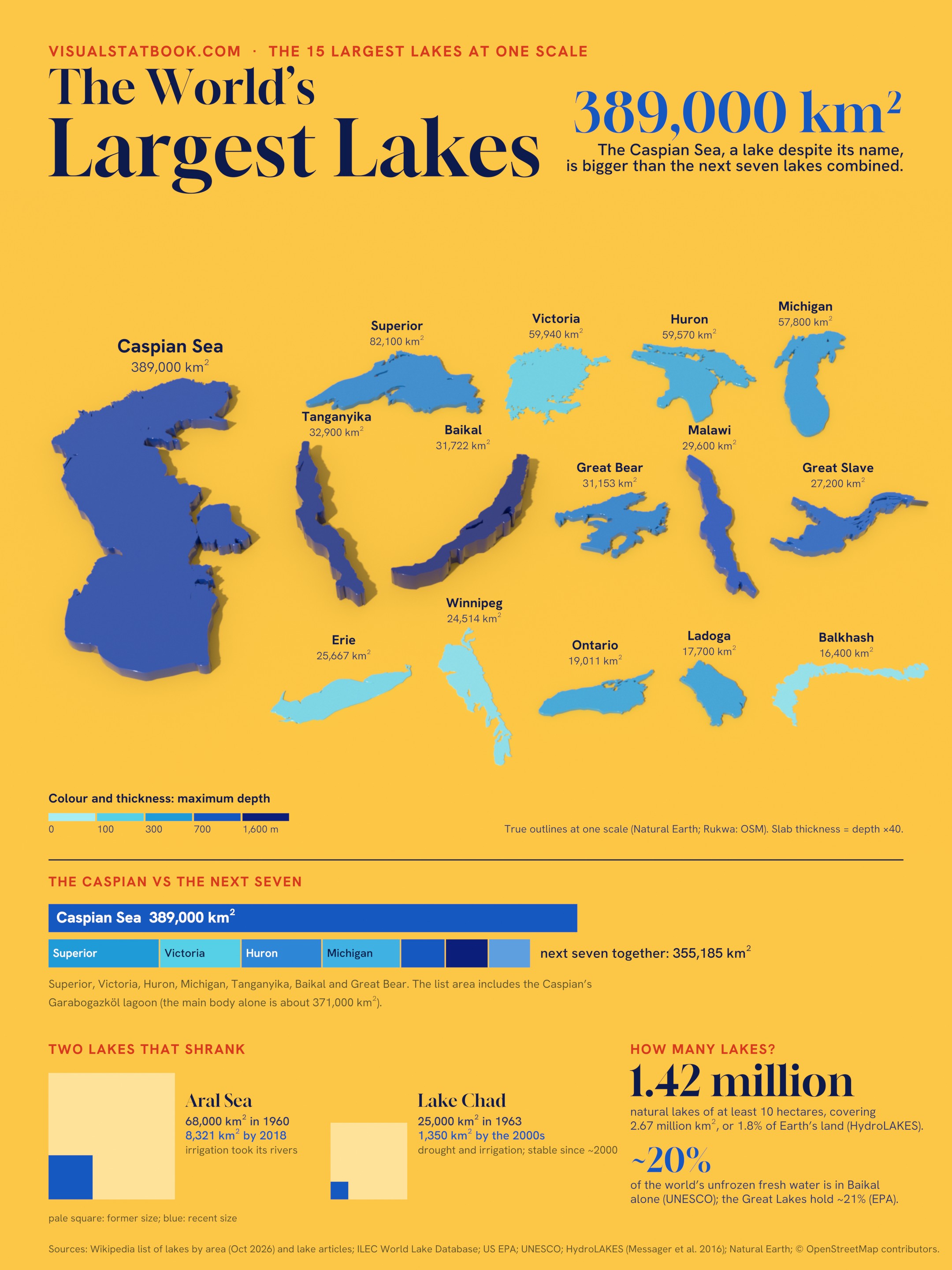
The same-scale slabs, the Caspian against the next seven, and two shrinking lakes on a 2160 × 2880 poster.
Open the full-size posterShow the full data table
| # | Lake | Countries | Area km² | Max depth m | Volume km³ | Elevation m | Water |
|---|---|---|---|---|---|---|---|
| 1 | Caspian Sea* | Kazakhstan, Russia, Azerbaijan, Iran, Turkmenistan | 389,000 | 1,025 | 78,200 | −28 | Saline |
| 2 | Lake Superior | Canada, United States | 82,100 | 406 | 12,070 | 183 | Fresh |
| 3 | Lake Victoria† | Tanzania, Uganda, Kenya | 59,940 | 81 | 2,420 | 1,135 | Fresh |
| 4 | Lake Huron | Canada, United States | 59,570 | 229 | 3,520 | 176 | Fresh |
| 5 | Lake Michigan | United States | 57,800 | 282 | 4,930 | 176 | Fresh |
| 6 | Lake Tanganyika | Tanzania, DR Congo, Burundi, Zambia | 32,900 | 1,470 | 18,750 | 773 | Fresh |
| 7 | Lake Baikal | Russia | 31,722 | 1,642 | 23,610 | 455.5 | Fresh |
| 8 | Great Bear Lake | Canada | 31,153 | 446 | 2,234 | 156 | Fresh |
| 9 | Lake Malawi | Malawi, Mozambique, Tanzania | 29,600 | 706 | 8,640 | 468 | Fresh |
| 10 | Great Slave Lake | Canada | 27,200 | 614 | 1,115 | 156 | Fresh |
| 11 | Lake Erie | Canada, United States | 25,667 | 64 | 488 | 173 | Fresh |
| 12 | Lake Winnipeg | Canada | 24,514 | 36 | 294 | 217 | Fresh |
| 13 | Lake Ontario | Canada, United States | 19,011 | 244 | 1,631 | 74 | Fresh |
| 14 | Lake Ladoga | Russia | 17,700 | 260 | 837 | 5 | Fresh |
| 15 | Lake Balkhash | Kazakhstan | 16,400 | 26 | 100 | 341.4 | Saline |
| 16 | Lake Onega | Russia | 9,700 | 127 | 291 | 33 | Fresh |
| 17 | Lake Titicaca | Peru, Bolivia | 8,372 | 281 | 896 | 3,812 | Fresh |
| 18 | Lake Nicaragua | Nicaragua | 8,264 | 26 | 110 | 32.7 | Fresh |
| 19 | Lake Athabasca | Canada | 7,850 | 124 | 204 | 213 | Fresh |
| 20 | Reindeer Lake‡ | Canada | 6,650 | 219 | 113 | 337 | Fresh |
| 21 | Lake Turkana | Kenya, Ethiopia | 6,405 | 109 | 193 | 360.4 | Saline |
| 22 | Issyk-Kul | Kyrgyzstan | 6,236 | 668 | 1,736 | 1,607 | Saline |
| 23 | Vänern | Sweden | 5,650 | 106 | 153 | 44 | Fresh |
| 24 | Lake Rukwa‡ | Tanzania | 5,615 | 22.5 | 58.2 | 800 | Saline |
| 25 | Lake Albert | Uganda, DR Congo | 5,590 | 51 | 133 | 619 | Fresh |
| 26 | Nettilling Lake | Canada | 5,542 | 132 | 130 | 30 | Fresh |
| 27 | Lake Winnipegosis | Canada | 5,370 | 12 | 17.2 | 254 | Fresh |
| 28 | Lake Mweru | Zambia, DR Congo | 5,120 | 27 | 38 | 917 | Fresh |
| 29 | Lake Nipigon | Canada | 4,848 | 165 | 266 | 260 | Fresh |
| 30 | Lake Manitoba | Canada | 4,706 | 7 | 14.1 | 247.5 | Saline |
* The Caspian Sea’s 389,000 km² includes the Garabogazköl lagoon; its main body is about 371,000 km².
† Lake Victoria’s area varies between sources: 59,940 km² here, but 68,800 km² (ILEC), 69,484 km² (Britannica) and 62,940 km² (CIA). It ranks third under every one of them.
‡ Lake Rukwa’s area swings strongly with its rivers (3,000 to 5,760 km² in different sources), and ranks 23 to 25 are within 1% of each other. Reindeer Lake’s figure includes its islands. Lake Michigan and Lake Huron, joined at the Straits of Mackinac, would rank second as one lake (about 117,400 km²).
Questions
Lakes FAQ
What is the largest lake in the world?
The Caspian Sea, at 389,000 km². That figure includes the Garabogazköl lagoon; the main body alone is about 371,000 km². It is bigger than the next seven lakes combined (355,185 km²), and five countries share its shore.
What is the largest freshwater lake in the world?
Lake Superior, with 82,100 km², is the largest freshwater lake by surface area. If Lake Michigan and Lake Huron, which are joined at the Straits of Mackinac, are counted as one lake, Michigan–Huron (about 117,400 km²) is larger. By volume, Lake Baikal holds the most fresh water (23,610 km³).
Which is the deepest of the 30 largest lakes?
Lake Baikal in Russia, at 1,642 m, followed by Lake Tanganyika at 1,470 m. Baikal is also the oldest lake on Earth and holds about 20% of the world’s unfrozen fresh water (UNESCO). The shallowest of the 30 is Lake Manitoba, only 7 m deep at its deepest point.
How many lakes are there in the world?
The HydroLAKES database maps about 1.42 million natural lakes of at least 10 hectares, with a combined surface of 2.67 million km² (1.8% of Earth’s land) and about 181,900 km³ of water (Messager et al. 2016). Countless smaller ponds are not counted.
Why is the Caspian Sea called a sea if it is a lake?
It is landlocked and has no outflow to the ocean, so geographers count it as an endorheic lake, the largest on Earth. It is called a sea because of its size, its slightly salty water (about a third of ocean salinity) and its geology: it sits on oceanic crust, a remnant of the ancient Paratethys Sea.
What is the combined area of the Great Lakes?
About 244,148 km², the sum of Superior, Michigan, Huron, Erie and Ontario (the US EPA gives 244,160 km²). Together they hold about 22,684 km³ of water, around 21% of the world’s surface fresh water (US EPA).